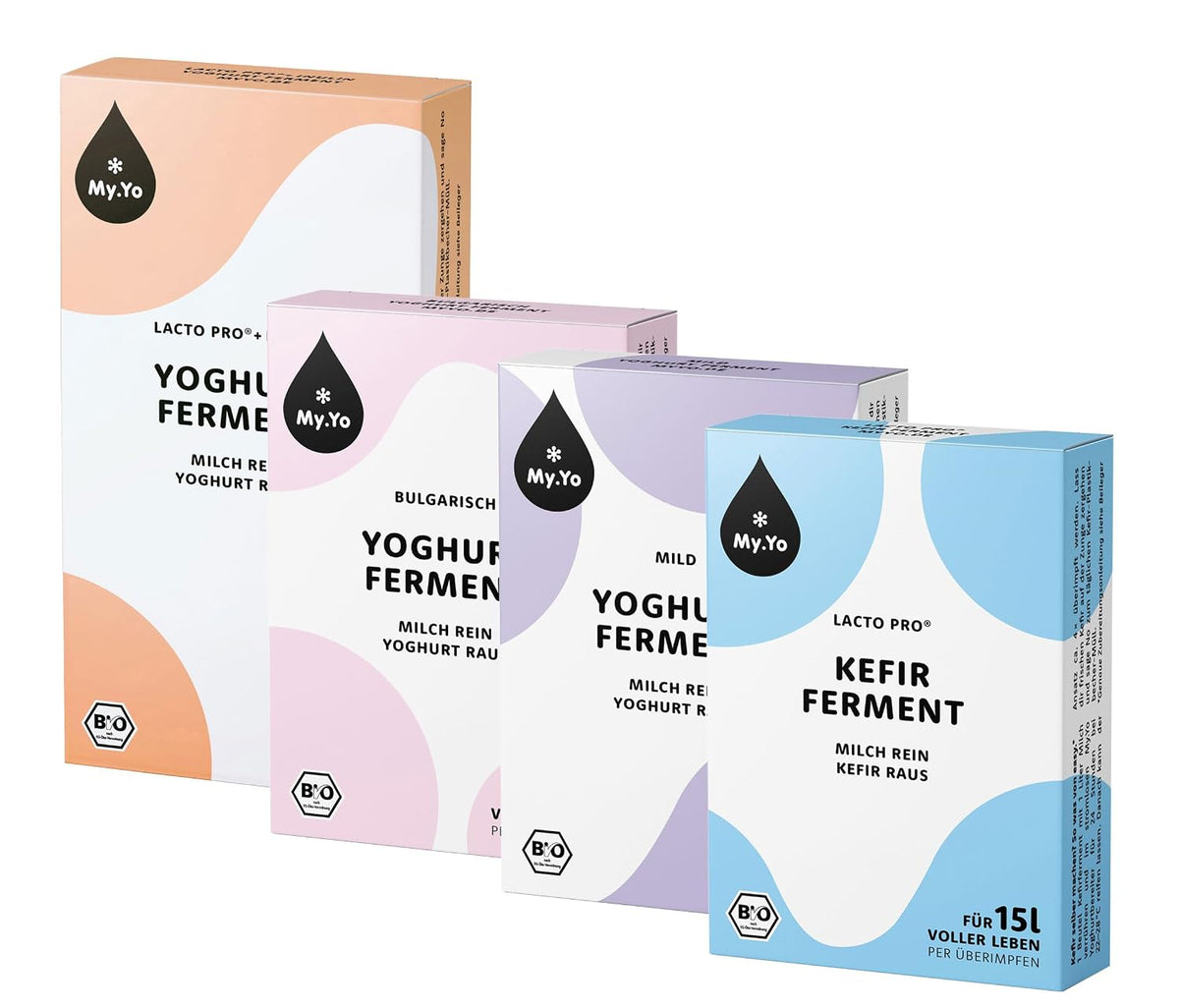
Bio Joghurt- & Kefirfermente – 4er Probier-Set
Tax included. Shipping calculated at checkout
Delivery within 3-5 days
 Certified Organic
Certified according to EU organic regulations – no additives, no genetic engineering. Verified organic quality.
Making yogurt at home helps reduce packaging waste.
Description
Vier Sorten entdecken – Joghurt und Kefir selber machen
Mit dem My.Yo Bio Probier-Set lernst du vier unterschiedliche Fermente kennen: Mild, Bulgarisch, Lacto Pro® + Inulin und Kefir Lacto Pro®. Entdecke deinen Lieblingsjoghurt und bereite auch frischen Kefir ganz einfach zu Hause zu.
Das enthält dein 4er Probier-Set:
• Bio Joghurtferment Mild: Für cremigen Joghurt mit besonders mildem Geschmack. 3 Beutel à 5 g.
• Bio Joghurtferment Bulgarisch: Für klassischen Joghurt mit kräftigerem, leicht säuerlichem Geschmack. 3 Beutel à 5 g.
• Bio Joghurtferment Lacto Pro® + Inulin: Mit den Kulturen LA-5® und BB-12® sowie Bio-Inulin, einem pflanzlichen Ballaststoff. 3 Beutel à 25 g.
• Bio Kefirferment Lacto Pro®: Für einen erfrischenden Kefirdrink – ohne Kefirknolle. 3 Beutel à 5 g.
Insgesamt erhältst du 12 einzeln portionierte Beutel mit 120 g Gesamtinhalt. Ein Beutel reicht für einen Ansatz mit 1 Liter Milch.
So einfach funktioniert die Zubereitung
Rühre einen Beutel Ferment in 1 Liter Milch ein und bereite den Ansatz nach der Anleitung der jeweiligen Sorte zu. Die Joghurtfermente reifen etwa 12–14 Stunden, das Kefirferment etwa 24 Stunden. Anschließend im Kühlschrank durchkühlen lassen.
Die Fermente eignen sich für die Zubereitung im My.Yo Joghurtbereiter. Ein Joghurtbereiter ist nicht im Set enthalten.
Kann ich den fertigen Joghurt weiterverwenden?
Ja, du kannst einen Teil deines selbstgemachten Joghurts oder Kefirs als Starter für den nächsten Ansatz verwenden. Beachte dafür die Hinweise zum Überimpfen in der jeweiligen Produktanleitung.
Für wen eignet sich das Probier-Set?
Für alle, die Joghurt und Kefir selbst herstellen, verschiedene Kulturen ausprobieren oder ihren persönlichen Favoriten finden möchten.
Alle vier Fermente sind bio-zertifiziert und werden in Deutschland hergestellt.
Fermentation time
Nutritional values per 100 g dry product
Ingredients
Origin & Certification
Made in Germany. Certified organic according to EU organic regulations (DE-ÖKO-001).
All ingredients come from controlled organic farming.
Storage & Shelf Life
Store in a dry place at room temperature. During hot summer months, we recommend storing in the refrigerator. Best before date: see packaging. Once opened, use immediately.
This product has no reviews yet.

It's that easy
FAQ about our ferments
About the cultures
Yogurt cultures are living microorganisms, such as specific bacterial strains, contained in our organic yogurt starters.
These cultures are used to ferment milk into yogurt and have been used in food production for many years.
How much yogurt can I make with one sachet?
Each pack contains 3 or 6 sachets. One sachet is sufficient to turn 1 litre of milk into yogurt.
Each sachet can be re-cultured up to 4 times (sometimes more). With one sachet, you can produce up to 5 litres of yogurt.
Important: always work under clean conditions to avoid contamination.
How does re-culturing work?
- You need a small amount of yogurt (approx. half a cup) with active cultures as a starter. This can be store-bought yogurt or some of your own homemade yogurt.
- Stir the starter into 1 litre of milk and let it ferment in the yogurt maker.
What fat content should the milk have?
- As a general rule: The higher the fat content, the firmer and creamier the yogurt.
- For example, low-fat milk (0.5%) will result in a more liquid, drinkable yogurt.
Are your products vegan?
Our starters are not certified as vegan. However, the ingredients themselves are plant-based.
How should I store the starters?
The starters can be stored at room temperature.
During hot summer months, it is recommended to store them in the refrigerator.
How long do the starters last?
Typically, our starters have a shelf life of6–12 months.
Can I use fresh milk or only UHT milk?
- Raw milk or fresh milk with a short shelf life should always be boiled first.
- Raw milk is untreated and may contain small amounts of natural bacteria. While this is usually harmless when consumed as milk, these bacteria can multiply during fermentation and affect the yogurt.
- Important: allow the milk to cool down before adding the yogurt starter.
If the milk is too hot, the cultures may be damaged.